

Biocouture is a concept where bacteria are used to produce materials that can be used to manufacture clothes. It is also the name of a Tech start-up company founded by Suzanne Lee, the first person to develop this idea.
Suzanne Lee
Suzanne Lee is synonymous with biocouture. She is an American Senior Research Fellow at Central Saint Martins College of Art and Design and the Director of The BioCouture Research Project. Back in 2003, she was talking about how we should be thinking drastically differently about how we produce clothes. She envisaged ‘a dress from a vat’ – basically using single-celled bacteria to produce fabrics.
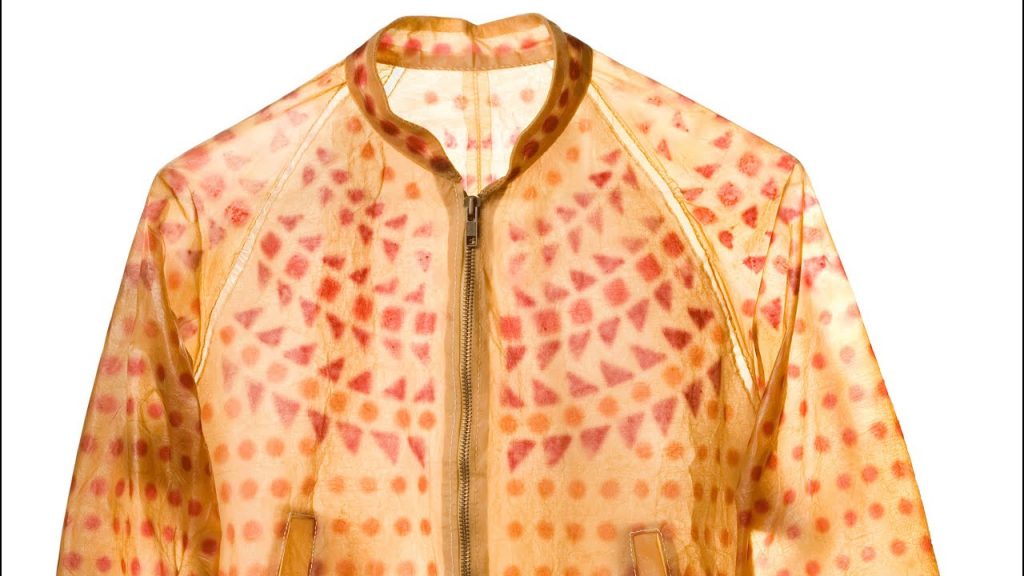
Bacterial Cellulose
Suzanne has experimented with a mix of different organisms and has managed to produce bacterial cellulose from them that is a bit like leather. She has even designed and produced real clothes from her material which London’s Science Museum has exhibited.
In her words;
“The recipe that I’ve been exploring to grow a piece of clothing is using a symbiotic mix of yeast and bacteria,” she said. “It’s a fermentation method that grows bacterial cellulose. It’s kind of like a vegetable leather if you like.”
“What attracts me to it is that it’s compostable. It’s not just biodegradable, it’s compostable. So you could throw it away like you would your vegetable peelings.”
Cradle to Grave
The cradle to grave concept looks at something we use and considers every step of production and disposal; mining or farming raw materials, the processes used to convert raw materials into something that can be used, transportation costs, carbon footprint and the ease of disposal. Looking at the entire life cycle of a substance gives us a complete picture of its sustainability, disposability and total environmental impact.
For the textiles industry, this is illuminating. Cotton is a natural product but it uses vast amounts of water to grow and process it. So although it is a natural product its use has a huge negative impact on our environment. Man-made, synthetic fabrics like polyester, come from fossil fuels and are one of the biggest sources of microplastic pollution. Their manufacture and the fact they don’t degrade mean their environmental impact is significant and negative.
These facts are what is driving the biocouture movement. What if we could grow our fabrics in a small vat rather than use vast fields for cotton or mine petrochemicals? What if there was virtually no processing needed at all – no bleaching, chemical processes or washing? What if they could be produced where they are needed without being transported halfway across the globe? What if after we had finished with the clothes we could simply compost them into 100% non-toxic organic matter we can simply add to our veg patch?
Fermented Fabrics!
The biocouture model uses sugar-rich agricultural waste to feed a range of single-celled organisms such as bacteria and fungi in a fermentation process. It is basically like brewing beer with a different type of final product.
Single-Celled Revolution
It isn’t just the clothes industry that is looking towards singled celled organisms as their future.
Packaging producers are experimenting with fungi to grow biodegradable replacements for products like bubble wrap and polystyrene.
The food industry started with Quorn, a fungi that can be grown in a vat to produce a meat substitute. New startups are now looking at other single-celled organisms to grow a ‘steak in a petri dish’ or ‘bacon in a jar’. Significant advancements are being made and commercially viable lab-grown meat is not very far off.
This technology has the potential to greatly improve our overuse of land, water and slow down the degradation of the few remaining wild spaces on our planet. The production of food, clothing and packaging in this way has an enormously smaller carbon footprint than traditional livestock farming methods.
In the words of Vincent Van Gogh “Great things are done by a series of small things brought together”!